
Real situations, not exercises
Order coffee, view a flat, practise a job interview or call in sick. Each conversation has a clear goal, with support at your level and room to try again.
Not flashcards with a voice bolted on. You hold conversations, and everything else — your notebook, your verb tables, your scores — comes out of them.
Around the conversations, the things that make them stick.
Order coffee, view a flat, practise a job interview or call in sick. Each conversation has a clear goal, with support at your level and room to try again.
Before a beginner conversation, or any English one, you can rehearse it in about two minutes. The character’s lines are recorded in advance; you say one of the suggested answers or your own, your answer decides where the conversation goes, and each one is scored for pronunciation. Next to every suggested answer, 🔊 plays it and 🎤 lets you practise it first. Then have the same conversation live, with a character who answers whatever you say.

Barcelona uses vosotros, Mexico City ustedes, Buenos Aires full voseo. Québec tutoies you where Paris would not. You learn the language someone actually speaks, in one place, rather than an average of everywhere.
A short conversation places you from A1 to C1 — no test, just talking. After that everyone speaks to you at your level: shorter sentences and one question at a time near the beginning, room to ramble later. If you are quiet, they slow down and offer you a choice instead of an open question.
Tell her what you feel like doing and she takes you there. She remembers where you have been, asks how it went, and notices patterns you cannot see in yourself — like a verb form you never once use.
A guide walks you through a real neighbourhood a stop at a time — what the building is, who lived there, why anyone cares — and you talk about it as you go. Same practice, different shape, for the days when another errand is not what you need.
Bring your own text — an email, a menu, a page of a book — and read it aloud a sentence at a time. Each line comes back scored syllable by syllable. The text is never stored: it exists only while you read it.
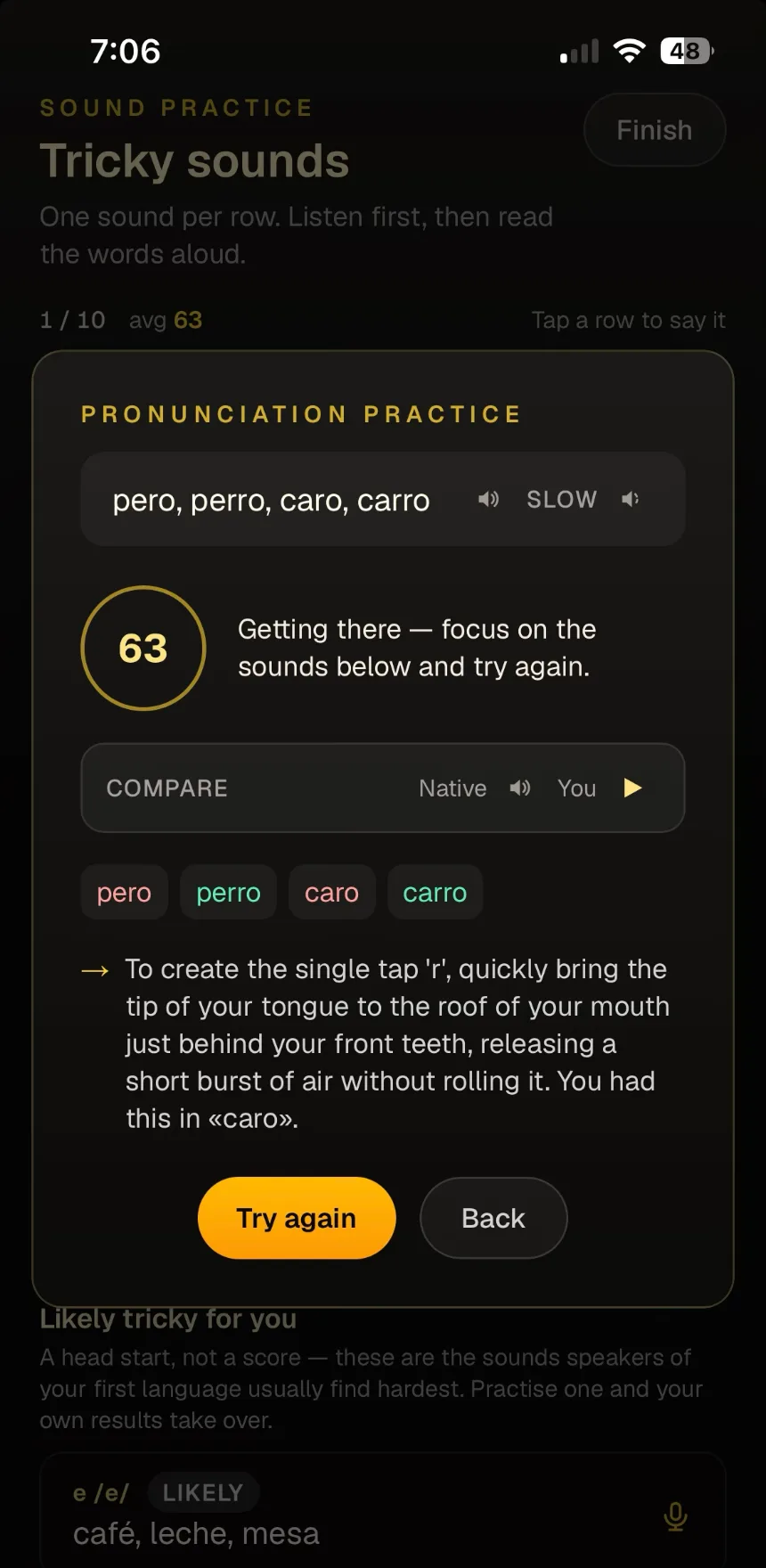
Not a pass or a fail: which syllable went wrong, and what to do about it. Hear yourself next to a natural reference voice, and work on the specific sounds you keep missing.
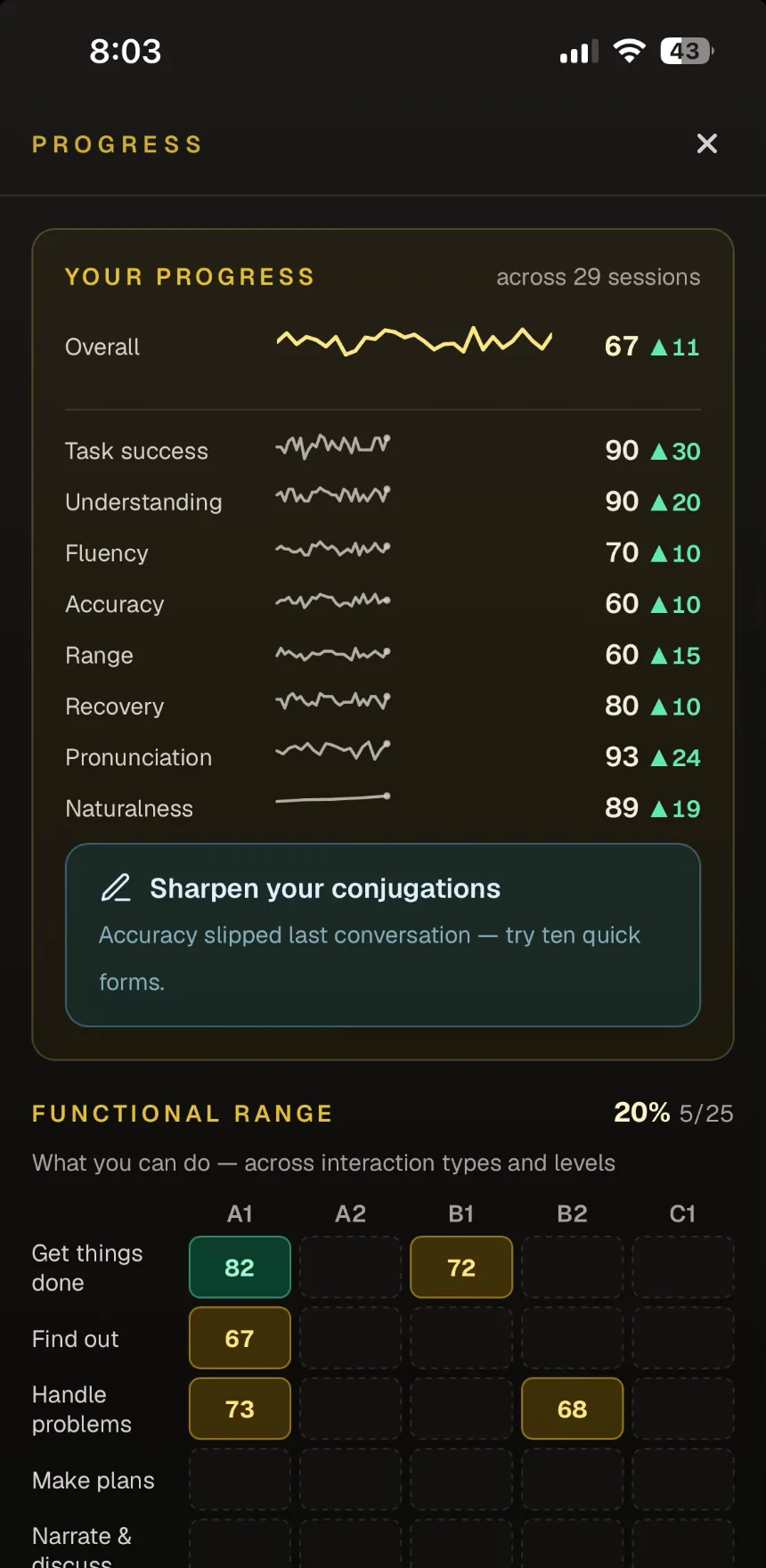
Every conversation is scored on what matters — did you get the task done, were you understood, did you recover when it went wrong — and plotted over time, so you can see the parts that are moving.
When a conversation shows you reaching for a form you do not have yet, a short note explains it with one example — the point you needed, when you needed it, not a lesson you did not ask for. Available for Spanish, English and Portuguese so far.
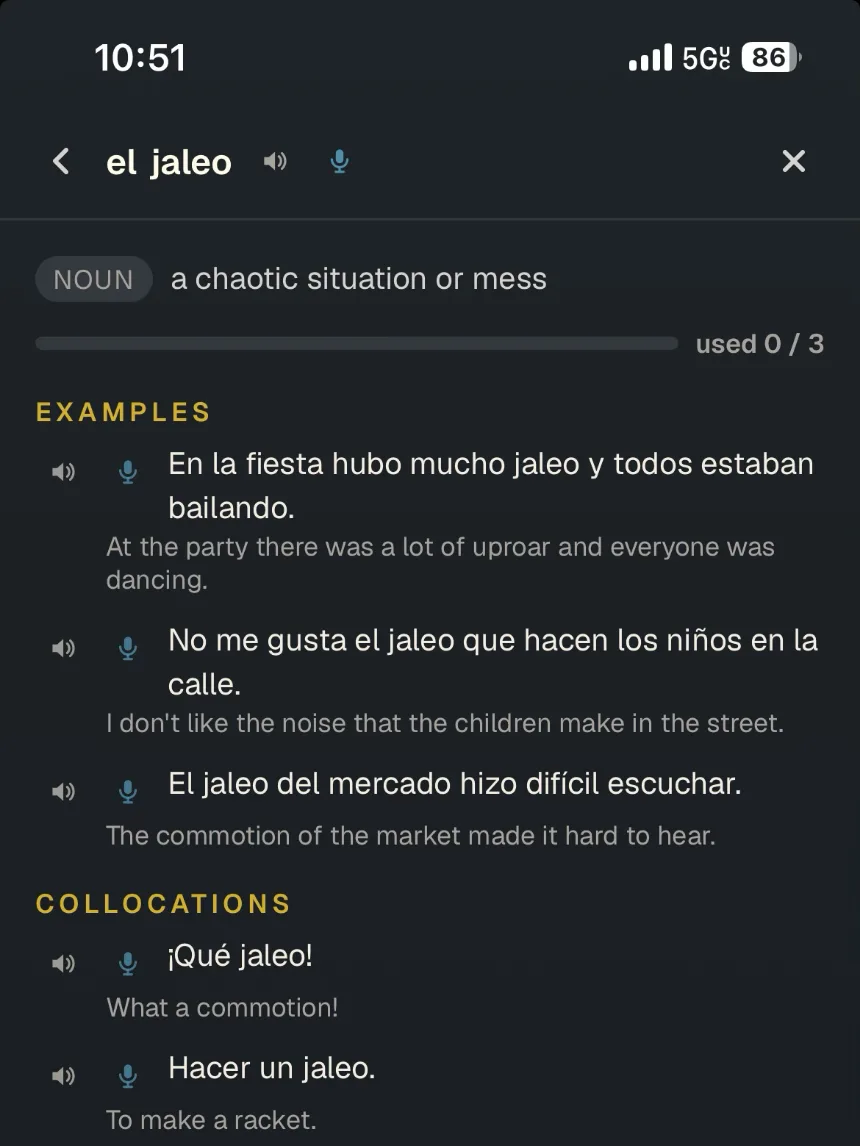
Tap any word you hear and it is saved with its meaning, examples and audio. Heard something out in the world instead? Look it up and keep that too. Words you have actually used are marked as yours.
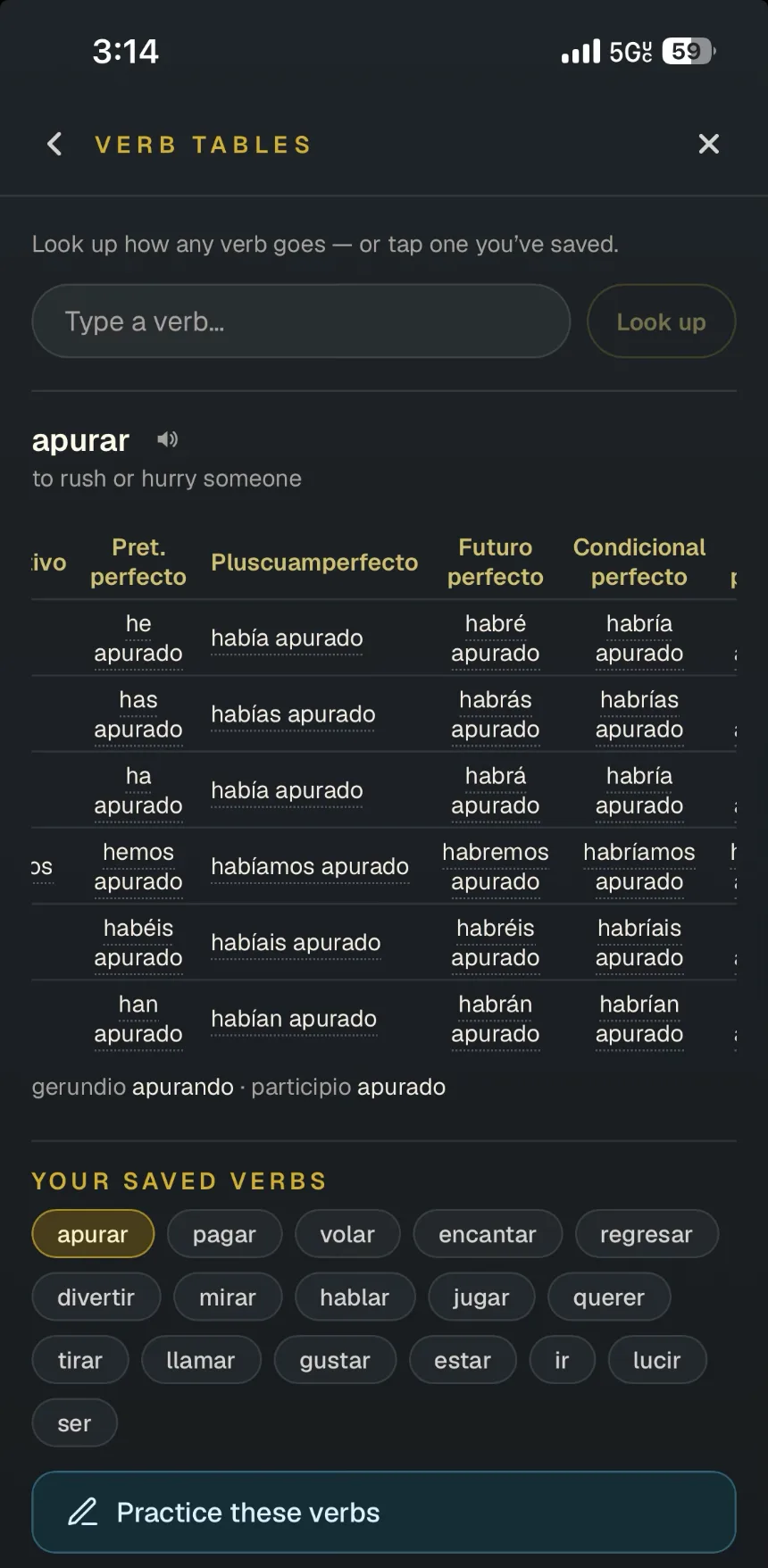
Every tense, including the compound ones. Tap any form and the companion starts a short conversation whose answers need exactly that form — because nobody ever learned to speak by reading a table.
The thousand words that carry most everyday speech, ranked by how often they are actually used. Tap one to hear it, save it, or practise the next ten in a short review — so the words you meet in conversation are the ones worth keeping.
Twenty-one everyday domains — food, health, housing, work, transport, the phone company — each filled in by the words you have genuinely mastered, not the places you have visited. You can see at a glance that you could handle a pharmacy but would still struggle at the bank, and which level you have practised each one at.
See which sound needs work—and how to make it.
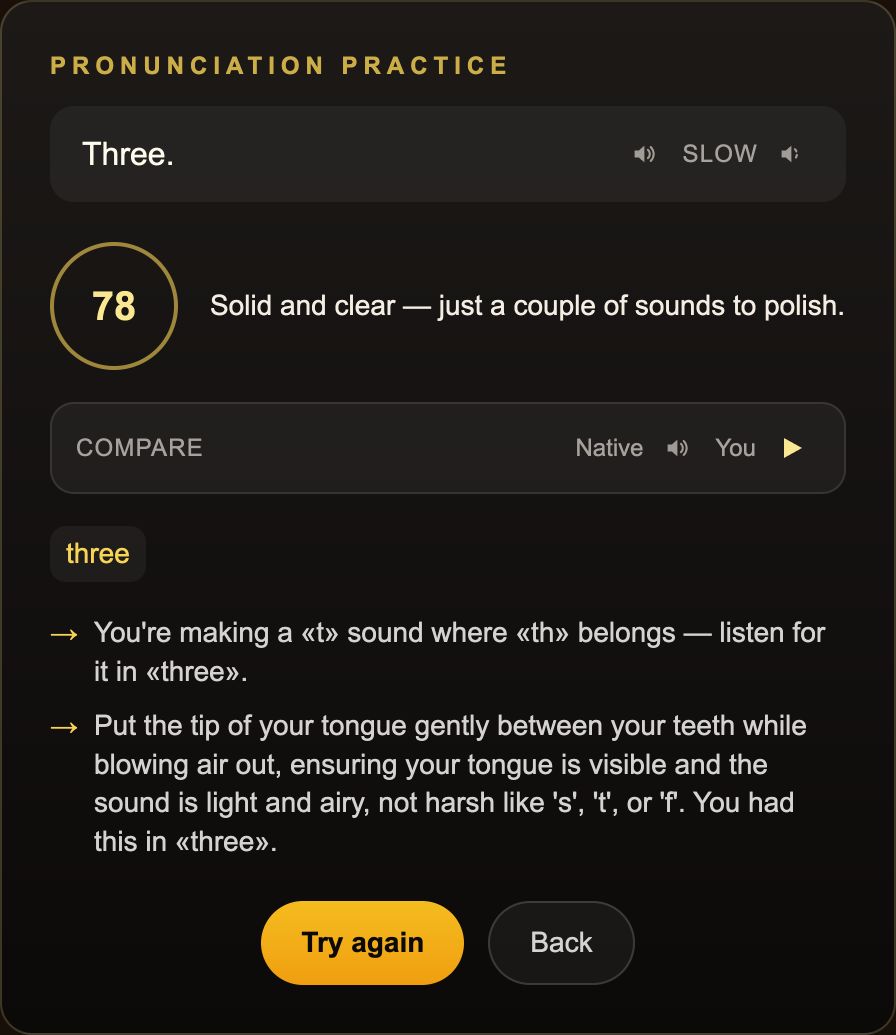 Tap to enlarge ↗
Try this: Place your tongue tip gently between your teeth and let air flow.
Try pronunciation practiceReal app interface, shown in English. The attempt uses an AI voice; the feedback was measured from that simulated attempt.
Choose a track for the conversation you want to have.
Your name, one coffee, a piece of fruit, a metro ticket — and the first time a machine eats your coins and you have to say so.
6 stepsBuild your answers from your own experience, handle unexpected questions and finish with a mock interview and feedback.
13 stepsRehearse the check-in, your answers to the officer, and the oath, with reading, writing and civics practice along the way.
11 stepsA bus is a colectivo in Buenos Aires, a pesero in Mexico City and a guagua in San Juan. Every language here splits the same way — Québec French is not Paris French, São Paulo Portuguese is not Lisbon Portuguese — and your local speaks the variety you chose. Spanish is where we have mapped it word by word:
| Meaning | 🇦🇷 Buenos Aires | 🇲🇽 Mexico City | 🇪🇸 Madrid | 🇵🇷 San Juan |
|---|---|---|---|---|
| the bus | colectivo | pesero | autobús | guagua |
| a straw | sorbete | popote | pajita | sorbeto |
| popcorn | pochoclo | palomitas | palomitas | popcorn |
| dude | che | güey | tío | pana |
| money | guita | lana | pasta | chavos |
By country: 🇦🇷 Argentina · 🇨🇱 Chile · 🇨🇴 Colombia · 🇩🇴 Dominican Republic · 🇪🇸 Spain · 🇲🇽 Mexico · 🇵🇪 Peru · 🇵🇷 Puerto Rico
Listen to a character from Loquala, then try speaking in the app.

Oi! Tudo bem?
Bonjour ! Je vous écoute.
Siéntese nomás. ¿Sopa o caldo?
Karibu, my dear! What can I get you?Tap a city to hear how the locals actually talk.
Spanish · French · Portuguese · English — real regional dialects, not one generic voice per language. More languages and cities on the way.
Every cell is backed by ASALE's Diccionario de americanismos, a national dictionary, or a native speaker who says where they're from. Where we couldn't source it, the cell stays blank.
Our regional-vocabulary cards have been read 17,000+ times on r/Spanish and r/SpanishLearning — and corrected by natives, which is the point.
It is speaking practice, not a course. There are short grammar notes when you slip, not grammar lessons, and it will not replace talking to real people — nothing does. What it gives you is somewhere to be bad at a language at two in the morning, with nobody's face changing.