🇧🇷 São Paulo · Portuguese
Learn Brazilian Portuguese in São Paulo
Choose your first conversation
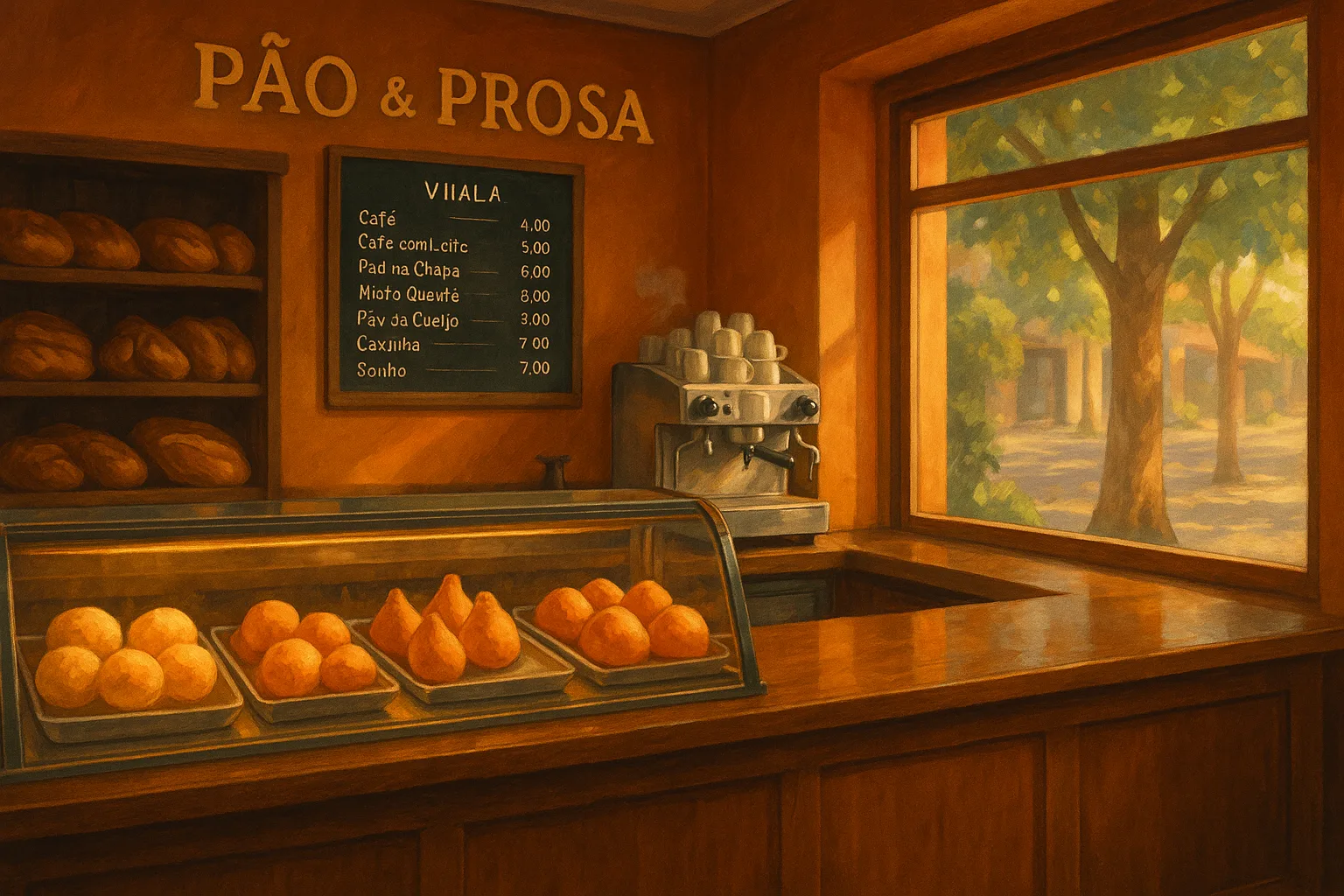
Brazilian Portuguese is warm, open-vowelled and everywhere — and the padaria is its natural habitat. Bia's counter in Vila Madalena teaches you the daily liturgy: «e aí, beleza?», the cafezinho offered before you ask, «valeu» on the way out.

Oi! Tudo bem?
How São Paulo actually talks
What you'll pick up
- Brazilian sound and rhythm — the open vowels, the -te that becomes -chi
- Everyday paulistano vocabulary: beleza, valeu, cafezinho, pão de queijo
- Real transactions with real numbers — reais, troco, the maquininha
Where you'll practise in São Paulo
107 missions across 11 scenes and 1 guided tour. Each mission is a real errand with a goal, a person who talks back, and a debrief afterwards in your own language.
-
Boteco do Craque boteco
Rafa, Bartender at a boteco in Vila Madalena, São Paulo · 13 missions · A1–C1
- One drink A1 — Say hi to Rafa, ask for one drink, answer his one either/or, and pay. Your very first boteco order.
- Meet Rafa A2 — Grab a stool at the boteco and get to know Rafa — your name, where you're from, why you're here.
- Make a plan A2 — Rafa invites you to watch the game. Say yes and agree a day and a time.
+ 10 more at this scene
Start speaking — free → -
Consultório do Dr. Paulo consultório médico
Dr. Paulo, GP at a small São Paulo practice · 9 missions · A1–C1
- Meet Dr. Paulo A1 — Before the exam starts, say hi to Dr. Paulo and find out his name and how long he has been a doctor.
- Dói aqui A1 — Tell Dr. Paulo one thing that hurts, answer one easy question, and hear one simple piece of advice.
- A cold and a sore throat A2 — You've got a cold. Tell Dr. Paulo how you feel, answer a couple of easy questions, and follow his simple advice.
+ 6 more at this scene
Start speaking — free → -
Galpão Cinco — a sala da Tânia escritório
Tânia, Co-owner who runs operations and does the hiring at a coworking space in Pinheiros, São Paulo · 8 missions · A1–C1
- The first minute A1 — Hello, your name, why you're here, the time, the person. The four sentences that get you through any office door.
- Availability A2 — What you do now, which days, which shift, when you can start — and the one question you must ask back: what does it pay?
- Your turn to ask B1 — «Agora é a sua vez.» The hotel years, the tinturaria in Liberdade, why she left, and Jean-Robert. Get to know the person who'd be your boss.
+ 5 more at this scene
Start speaking — free →
Explore all 11 scenes
-
Drogaria Bem-Estar farmácia
Célia, Pharmacist at a neighbourhood São Paulo pharmacy · 10 missions · A1–C1
- Uma coisa A1 — Ask Célia for one simple thing and pay. Your very first pharmacy visit.
- Wrong medicine A1 — Célia brought the wrong item. Say so — in a few words — and let her fix it.
- Come back for it A2 — The medicine you want is out of stock. Agree a simple time with Célia to come back.
+ 7 more at this scene
Start speaking — free → -
Feira da Vila feira
Seu Jorge, Fruit-and-veg seller at a São Paulo street market · 10 missions · A1–C1
- Uma fruta A1 — Ask Seu Jorge for one piece of fruit and pay. Your very first feira visit.
- Come back Saturday A1 — Today's mangoes aren't ripe yet. Say a simple day you'll come back for the good ones.
- Childhood fruit A2 — Seu Jorge asks about your favourite fruit as a kid. Tell him, in a few simple sentences.
+ 7 more at this scene
Start speaking — free → -
Imobiliária Quaresmeira — o apartamento da Rua do Cedro visita a apartamento
Cida, Rental broker at a neighbourhood estate agency in Vila Madalena, São Paulo · 8 missions · A1–C1
- Vim ver o apartamento A1 — Name, reason, two questions: how many rooms and how much. The simplest way into a São Paulo flat.
- Quanto é tudo? A2 — Rent is the beginning of the bill, not the end. Get all three numbers and add them up out loud.
- The inspection B1 — Walk the flat with Cida on key day: name every defect, check what's missing, get it all on the laudo — then sign.
+ 5 more at this scene
Start speaking — free → -
Estação Faria Lima estação de metrô
Wesley, Metro station attendant in São Paulo · 9 missions · A1–C1
- One ticket A1 — Buy a single metrô fare from Wesley at Faria Lima and pay for it. The simplest possible first ride.
- Meet Wesley A1 — No route to work out — just say hi to Wesley and find out his name and how long he has worked the metrô.
- Your trip here A2 — Wesley asks how you got here today. Tell him, in a few simple sentences.
+ 6 more at this scene
Start speaking — free → -
Auto Center Nelson oficina mecânica
Nelson, Mechanic-owner of a small oficina mecânica in São Paulo · 10 missions · A1–C1
- Too expensive A1 — Nelson names a simple price. Tell him — in a few words — that it's too much for you.
- Since when? A1 — Nelson listens to the engine and asks about the noise's history. Tell him three tiny simple facts.
- Drop off the car A2 — Tell Nelson what noise your car is making and leave it with him to take a look.
+ 7 more at this scene
Start speaking — free → -
Pão & Prosa padaria
Bia, Owner of a neighbourhood padaria and café in Vila Madalena, São Paulo · 12 missions · A1–C1
- Café da manhã A1 — Order a coffee and a pão de queijo at the padaria counter and pay.
- Lanche da tarde A2 — Grab an afternoon salgado and a juice — ask what's fresh and pay.
- Encomendar um bolo B1 — Order a birthday cake at the padaria: flavour, size, pickup day, and a deposit.
+ 9 more at this scene
Start speaking — free → -
Parque Ibirapuera parque
Zilda, Coconut-water vendor with a cart by the lake in Parque Ibirapuera, São Paulo · 8 missions · A1–C1
- A coconut water A1 — Your first Portuguese purchase in the open air: say hi, ask for a coconut water, pick a size, pay.
- Order for two A2 — Two drinks from the cart, the coconut opened for the polpa, and paying by pix — an everyday Brazilian counter transaction with no counter.
- Pra galera B1 — Order for four at Zilda's cart — mixed items, one thing sold out, one coconut to open for the polpa — check the total and pay.
+ 5 more at this scene
Start speaking — free → -
O táxi do Edson taxi
Edson, São Paulo taxi driver · 10 missions · A1–C1
- Book tomorrow's ride A1 — Edson offers to pick you up again tomorrow. Say a simple time that works.
- Pra Paulista A1 — Get in, say where you're going, answer one easy question, hear the fare and pay. Your first São Paulo taxi.
- A recent trip A2 — At a red light, Edson asks about a recent outing of yours. Tell him, in a few simple sentences.
+ 7 more at this scene
Start speaking — free →
Tours
- São Paulo à mesa: da padaria à doceria with Bia, Owner of a neighbourhood padaria and café in Vila Madalena, São Paulo — 4 stops: Pão de queijo e cafezinho, Coxinha na lanchonete, Pastel de feira e caldo de cana and Brigadeiro na doceria.
Words that change in São Paulo
Bia speaks the way São Paulo does, not the way a textbook does. A few of the swaps you'll hear from the first minute — the full list lives in the app's «Talk like a paulistano» guide:
| They say | It means | You'll hear |
|---|---|---|
| ônibus | bus elsewhere: autocarro | Vou pegar o ônibus na Paulista. Brazil says "ônibus"; Portugal says "autocarro". |
| celular | cell phone elsewhere: telemóvel | Meu celular tá sem bateria. Brazil "celular", Portugal "telemóvel". |
| geladeira | fridge elsewhere: frigorífico | Põe o refrigerante na geladeira. Brazil "geladeira", Portugal "frigorífico". |
| banheiro | bathroom / toilet elsewhere: casa de banho | Onde fica o banheiro? Brazil "banheiro"; in Portugal that word leans toward a lifeguard — they say "casa de banho". |
| suco | juice elsewhere: sumo | Um suco de laranja, por favor. Brazil "suco", Portugal "sumo". |
| sorvete | ice cream elsewhere: gelado | Bateu vontade de um sorvete. Brazil "sorvete", Portugal "gelado". |
| trem | train elsewhere: comboio | Peguei o trem pra Luz. Brazil "trem", Portugal "comboio". (In Minas, "trem" also means "thing"!) |
- mano — bro / dude The paulistano "bro" — used constantly, to friends of any gender loosely.
- massa — cool / awesome "Que massa" = how cool. Everyday in SP.
- da hora / daora — awesome / cool Strongly São Paulo. Something great.
- mó — really / super Short for "maior"; an intensifier — "mó legal" = super cool.
The full «Talk like a paulistano» guide — every word, phrase and habit of speech the São Paulo characters use, with what the other Portugueses say instead.
Questions people ask about São Paulo
Which Portuguese will I hear in São Paulo?
Brazilian Portuguese. Bia and the other locals in the São Paulo scenes speak the way people in São Paulo actually speak — accent, pace, register and vocabulary. They'll say ônibus for bus, celular for cell phone and geladeira for fridge, and the coach tells you when a word is local rather than universal.
Do I need to speak Portuguese already?
No. Missions in São Paulo run from A1 (first words: greet, order, ask for the bill) to C1 (argue a point, handle a complication, hold a real conversation). You pick a level, the scene meets you there, and the coach explains anything you missed in your own language.
What will I actually do in the São Paulo scenes?
107 missions across 11 scenes — Boteco do Craque, Consultório do Dr. Paulo, Galpão Cinco — a sala da Tânia and Drogaria Bem-Estar and more. Each mission is an errand with a goal: order, negotiate, describe a symptom, get directions, small-talk your way through a wait. The person you're talking to has their own agenda, so it never goes exactly to script. There is also a guided tour — São Paulo à mesa: da padaria à doceria — where the guide talks and you ask.
Is it free?
You can start speaking without creating an account. A free account keeps your notebook and progress and comes with 10 minutes of live conversation a week, refilled every Monday; the app tells you where you stand.
How does the feedback work?
Bia answers in Portuguese, and a separate coach watches the conversation and flags what to fix — grammar, a word choice that isn't São Paulo's, pronunciation — in your language, without interrupting the scene. Words you didn't know go into your notebook with the São Paulo pronunciation, and after each mission you get a debrief you can review.