🇪🇸 Barcelona · Spanish
Learn Spanish in Barcelona
Choose your first conversation
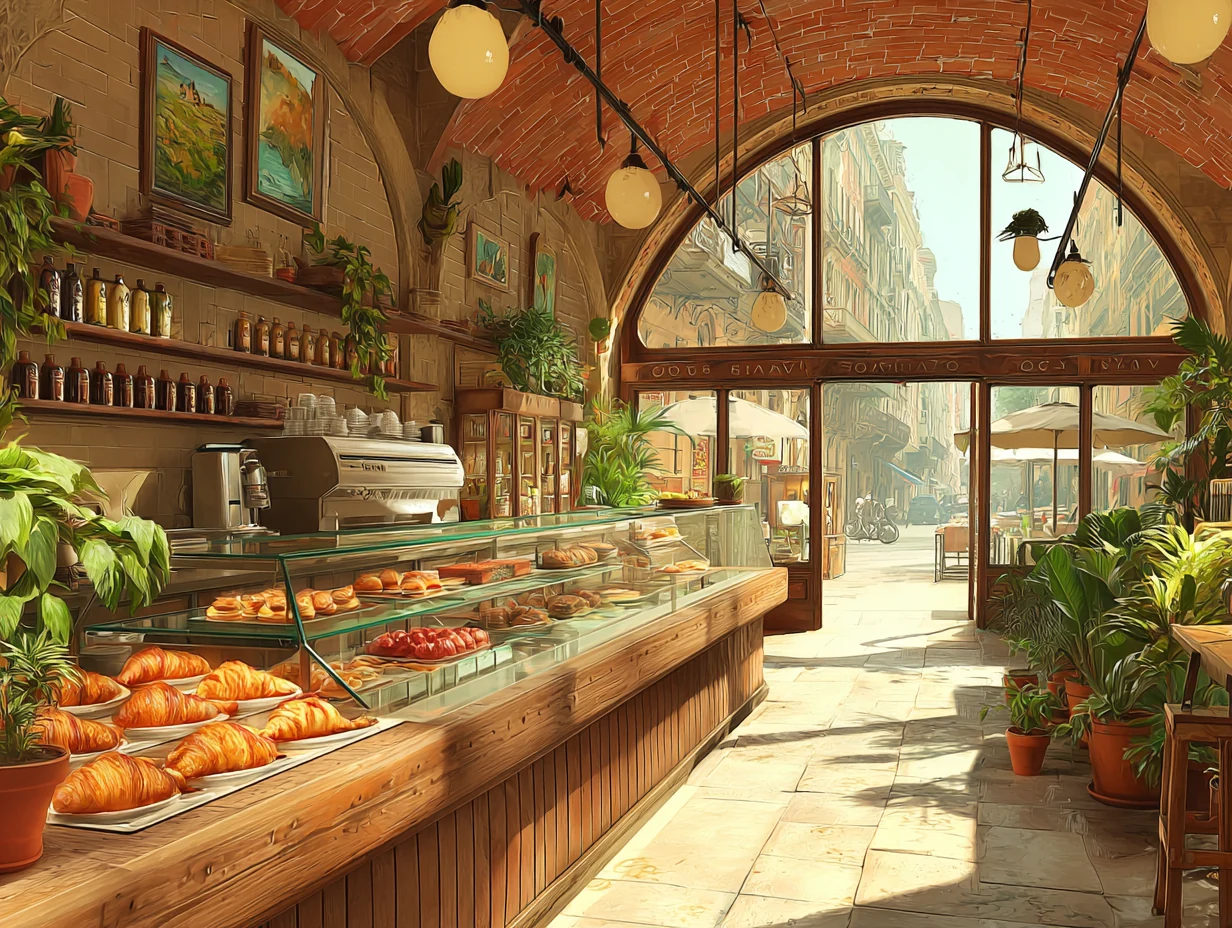
Barcelona Spanish is quick, warm and direct: the counter question is «¿Qué te pongo?», the coffee is a cortado, and «venga» ends half the sentences in the room. In Loquala you learn it standing at Jordi's counter — ordering, mishearing, recovering — not from a grammar table.

¡Hola! ¿Qué te pongo?
How Barcelona actually talks
What you'll pick up
- Spain's «vosotros» forms and the «distinción» of northern and central Spain, not a neutral Latin blend
- Café culture vocabulary that textbooks skip: cortado, tostada, «para llevar», «¿me cobras?»
- The rhythm of Spanish service talk — fast, friendly, and completely learnable
Where you'll practise in Barcelona
64 missions across 9 scenes and 1 guided tour. Each mission is a real errand with a goal, a person who talks back, and a debrief afterwards in your own language.
-
Consulta de la Dra. Vidal consulta médica
Dra. Vidal, GP at a small Barcelona practice · 6 missions · A2–C1
- A cold and a sore throat A2 — You've got a cold. Tell Dra. Vidal how you feel, answer a couple of easy questions, and follow her simple advice.
- Get to know Dra. Vidal B1 — A quiet moment after the appointment — just chat. Find out about her grandmother the village midwife, her sons in the castells team, and the plaça where she gets her coffee.
- See the doctor B1 — Describe your symptoms, answer Dra. Vidal's questions, and get a diagnosis, advice, and a prescription — the core doctor's visit.
+ 3 more at this scene
Start speaking — free → -
Finques Aiguallarga — el piso del Carrer del Robí visita de piso
Roser, Rental agent at a small neighbourhood estate agency in Gràcia, Barcelona · 7 missions · A1–C1
- The six o'clock viewing A1 — Name, appointment, two questions: how many rooms and how much. The simplest way into a Barcelona flat.
- Room by room A2 — See every room, ask what's included, and get the REAL monthly number — rent is only the first of three.
- Fifteen minutes with Roser B1 — The next viewing is late. Ask the agent about her twenty years of doors, her own rent, and whether Gràcia is still Gràcia.
+ 4 more at this scene
Start speaking — free → -
Hostal Puig hostal familiar
Oriol, Owner and front-desk host of a small family hostal in Gràcia, Barcelona · 5 missions · A1–B2
- I have a booking A1 — Arrive at a little family hostal in Gràcia, say you have a reservation, give your name, and get your key.
- Check-in A2 — A modernista hostal in Gràcia: give your name and nights, show your passport, choose breakfast or not, and get your keys and the wifi.
- Get to know Oriol B1 — A quiet hour in a family hostal. Find out how the Puigs started it, where Oriol sailed before, and what he dreams of building.
+ 2 more at this scene
Start speaking — free →
Explore all 9 scenes
-
Mercat de la Llibertat mercado
Neus, Fruit and vegetable seller at a Gràcia market · 6 missions · A1–B2
- Meet Neus A1 — Nothing to buy. Trade names with the market queen, ask where she's from, and say where you're from.
- Una pieza de fruta A1 — Ask Neus for one apple or one banana and pay. Your very first trip to the market.
- Buy fruit A2 — Ask the price, buy fruit by the kilo, and pay at the market stall.
+ 3 more at this scene
Start speaking — free → -
Estació Passeig de Gràcia estación de metro
Mercè, Metro station attendant in Barcelona · 5 missions · A1–B2
- One ticket A1 — Ask Mercè for a single metro ticket at Passeig de Gràcia and pay for it. Your first words underground.
- Broken machine A1 — The ticket machine swallowed your coins. Tell Mercè, point at it, answer her questions — she fixes everything.
- Comprar un billete A2 — New to the metro? Ask Mercè how to pay, what it costs, and how to get through the gate.
+ 2 more at this scene
Start speaking — free → -
Farmàcia Serra farmacia
Ana, Cashier at a neighbourhood Barcelona pharmacy · 7 missions · A1–B2
- Everyday items A1 — Grab sunscreen and plasters before the beach and pay.
- Cold remedy A2 — You've caught a cold — describe your symptoms and get a remedy.
- Wrong medicine B1 — Something's off with what you were given at the pharmacy. Explain the mix-up to Ana, weigh the options, and sort a fix.
+ 4 more at this scene
Start speaking — free → -
El taxi de Quim taxi
Quim, Barcelona taxi driver · 7 missions · A1–C1
- Your day in Barcelona A1 — Nothing to sort out — the ride is set. Just tell Quim three places you went today.
- A quick ride A2 — Hop in Quim's taxi: say where you're going, pick a route when he offers, find out roughly what it costs, and pay when you arrive.
- Get to know Quim B1 — A long ride, a driver who loves to talk. Find out how long he's driven, about his family and Montse's cooking, and the charm by his mirror.
+ 4 more at this scene
Start speaking — free → -
La Vermu de la Plaça bar
Pau, A local your age at a vermut bar in Gràcia · 10 missions · A1–C1
- Next Sunday, same plaça A1 — Pau invites you back for Sunday vermut. Say yes, pick a time, and say the plan back.
- Meet Pau A2 — Pull up a chair at the vermut bar and get to know Pau — a bit of small talk, where you're from, why you're here.
- Ask for the chair B1 — Two free-looking chairs at a stranger's table on a packed terrace. Ask if one's free — and handle the no.
+ 7 more at this scene
Start speaking — free → -
Cafè Montseny café
Jordi, Owner and waiter at Cafè Montseny · 11 missions · A1–C1
- Un café, por favor A1 — Order a coffee from Jordi and pay. Your very first visit to the café.
- Café y algo de comer A2 — Order a coffee and a bite from Jordi, to stay or to go, and pay.
- Dinner for two B1 — Order dinner, get a recommendation, survive a kitchen surprise.
+ 8 more at this scene
Start speaking — free →
Tours
- Historic Barcelona walking tour with Montse, Historic walking-tour guide in Barcelona — 5 stops: Parc de la Ciutadella (la Cascada Monumental), Casa Batlló, Casa Milà (La Pedrera), Catedral de Barcelona and Santa Maria del Mar.
Words that change in Barcelona
Jordi speaks the way Barcelona does, not the way a textbook does. A few of the swaps you'll hear from the first minute — the full list lives in the app's «Talk like a Spaniard» guide:
| They say | It means | You'll hear |
|---|---|---|
| coche | car elsewhere: carro | Voy a dejar el coche en el parking. In Spain a car is a "coche"; "carro" sounds Latin American (or means a shopping cart). |
| móvil | cell phone elsewhere: celular | Se me ha quedado el móvil sin batería. Universal in Spain; "celular" is Latin American. |
| ordenador | computer elsewhere: computadora | Trabajo todo el día con el ordenador. Spain says "ordenador" (from French); Latin America says "computadora". |
| zumo | juice elsewhere: jugo | Un zumo de naranja natural, por favor. In Spain fruit juice is "zumo"; "jugo" is the juice inside meat/fruit. |
| patata | potato elsewhere: papa | Una ración de patatas bravas. Spain "patata", Latin America "papa". |
| piso | flat / apartment elsewhere: apartamento | Comparto piso con dos amigos. The everyday word for an apartment in Spain. |
| billete | ticket (transport) elsewhere: boleto | ¿Dónde compro el billete de metro? Spain uses "billete" for transport/paper money; "boleto" is Latin American. |
- guay — cool / great The everyday word for "cool" in Spain.
- tío / tía — dude / mate (m/f) Literally uncle/aunt, but the go-to word for "dude" among friends.
- molar — to be cool / to like "Me mola" = "I love it / it's cool". Very Spain.
- flipar — to freak out / be amazed "Flipo" = I can't believe it / it blows my mind.
How Spain says 27 everyday words — next to what seven other Spanish-speaking countries say for the same thing, with a cited source for every filled cell. Or see all the words, eight ways.
Questions people ask about Barcelona
Which Spanish will I hear in Barcelona?
Spain Spanish. Jordi and the other locals in the Barcelona scenes speak the way people in Barcelona actually speak — accent, pace, register and vocabulary. They'll say coche for car, móvil for cell phone and ordenador for computer, and the coach tells you when a word is local rather than universal. For the vocabulary side, see how Spain says everyday words next to seven other countries at /spanish/spain/.
Do I need to speak Spanish already?
No. Missions in Barcelona run from A1 (first words: greet, order, ask for the bill) to C1 (argue a point, handle a complication, hold a real conversation). You pick a level, the scene meets you there, and the coach explains anything you missed in your own language.
What will I actually do in the Barcelona scenes?
64 missions across 9 scenes — Consulta de la Dra. Vidal, Finques Aiguallarga — el piso del Carrer del Robí, Hostal Puig and Mercat de la Llibertat and more. Each mission is an errand with a goal: order, negotiate, describe a symptom, get directions, small-talk your way through a wait. The person you're talking to has their own agenda, so it never goes exactly to script. There is also a guided tour — Historic Barcelona walking tour — where the guide talks and you ask.
Is it free?
You can start speaking without creating an account. A free account keeps your notebook and progress and comes with 10 minutes of live conversation a week, refilled every Monday; the app tells you where you stand.
How does the feedback work?
Jordi answers in Spanish, and a separate coach watches the conversation and flags what to fix — grammar, a word choice that isn't Barcelona's, pronunciation — in your language, without interrupting the scene. Words you didn't know go into your notebook with the Barcelona pronunciation, and after each mission you get a debrief you can review.