🇵🇪 Cusco · Spanish
Learn Andean Spanish in Cusco
Choose your first conversation
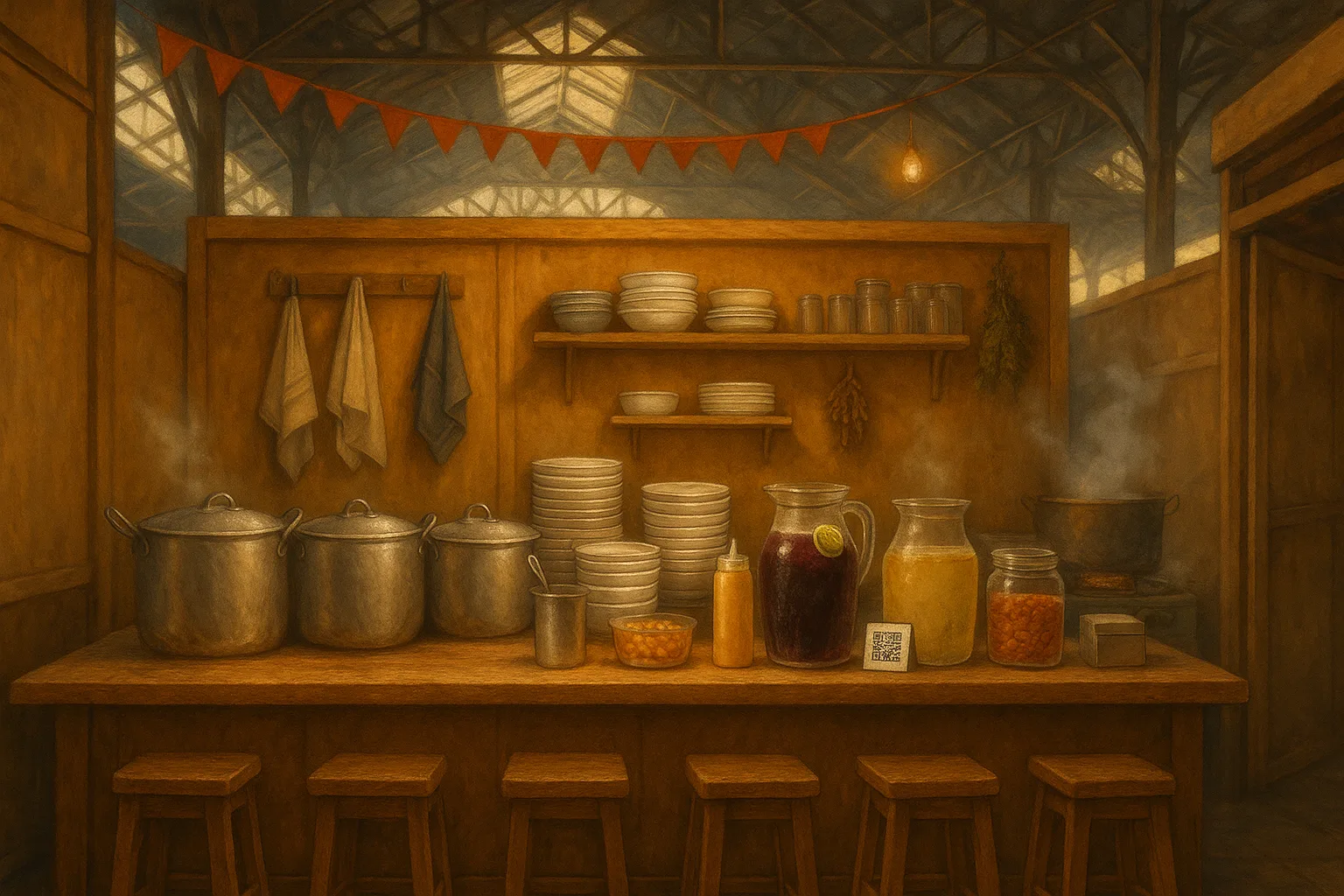
Cusco Spanish is unhurried and unusually clear — the consonants stay where they were put, which makes it a kind place to learn. What it adds is Quechua: chompa, choclo, wawa, and the «pe» tacked onto the end of a sentence. At Menú Doña Trini you eat the way the city eats at midday: a set lunch, entrada then segundo, ordered in two words and in front of you in three minutes — and the yapa is a real thing here, not a promotion.

Siéntese nomás. ¿Sopa o caldo?
How Cusco actually talks
What you'll pick up
- The «menú» itself — Peru’s set lunch, and the entrada/segundo choreography that gets you fed in three minutes
- Quechua living inside the Spanish: chompa, choclo, palta, wawa, chacra — and «pe», a sentence-final tag that rarely gets translated
- Andean clarity — slower, fully pronounced consonants — plus al toque, la yapa, causa and nomás
Where you'll practise in Cusco
35 missions across 6 scenes. Each mission is a real errand with a goal, a person who talks back, and a debrief afterwards in your own language.
-
Botica Doña Felícitas botica
Marleni, Pharmacist behind the counter of a small family botica near the Plaza de Armas, Cusco · 5 missions · A1–B2
- Something for the soroche A1 — 3,400 metres and a pounding head: ask the pharmacist for something for the soroche, and get her advice for free.
- Headache A2 — Say what hurts and since when, answer one safety question, pick between two tablets — and hear why water matters up here.
- Get to know Marleni B1 — An aunt who opened a botica in 1989, a girl from Sicuani, and a pharmacist who runs up to Sacsayhuamán for fun.
+ 2 more at this scene
Start speaking — free → -
La chacra de los Ccorimanya chacra
Bernardina, Farmer and seed keeper on her family's terraced chacra above the Sacred Valley, Cusco · 7 missions · A1–C1
- Arriving at the chacra A1 — Your name, how many of you, the price, and yes to lunch. Five short sentences at 3,700 metres.
- Sixty potatoes have names A2 — Purple, spotted, knobbly, black. Ask what three of them are called, describe them, and say the names back.
- The woman who keeps the seed B1 — Four generations, nine scattered plots, sixty varieties and one bad frost. Ask, then ask again.
+ 4 more at this scene
Start speaking — free → -
Hostal El Balcón Azul hostal
Yolanda, Owner of a family-run hostal in San Blas, Cusco, who works the reception herself · 5 missions · A1–B2
- Check in A1 — Up the cobbled street to a family hostal in San Blas: a reservation, a name, a passport, a key — and a cup of mate de coca.
- Check-in and mate A2 — Name, passport, a cup of coca or muña tea for the altitude — then find out when breakfast is and get the wifi.
- Get to know Yolanda B1 — Her grandparents' house, nine rooms, a Swiss cyclist who comes every year — and real advice for your first days at 3,400 metres.
+ 2 more at this scene
Start speaking — free →
Explore all 6 scenes
-
Menú Doña Trini puesto de menú
Nilton, Runs his mother's set-lunch counter in the Mercado de San Pedro, Cusco · 7 missions · A1–C1
- Order the set lunch A1 — Entrada, segundo, refresco — for one price, chosen out loud. Four one-word answers and lunch is served.
- Paying at the counter A2 — Ask for the bill, check the total, and solve the classic problem: nobody has change for a hundred before two o'clock.
- The counter his mother built B1 — A basket of potatoes in 1996, a hotel front desk, a closed market, and a mother who still calls at two o'clock.
+ 4 more at this scene
Start speaking — free → -
Peña Wayrapata peña
Teófilo, Runs the Peña Wayrapata in Cusco and plays quena in the house band · 6 missions · A1–C1
- Get in and sit down A1 — Fifteen soles, one drink included, and the tables at the back are the cold ones.
- What are they playing? A2 — Ten strings, six holes and a thumb hole, and a song that is far younger than you would guess.
- The man who opened the room B1 — A neighbour's cane flute, six years in Lima, two winters in Europe, and sixty chairs since 2011.
+ 3 more at this scene
Start speaking — free → -
El taxi de Wilber taxi
Wilber, Taxi driver in Cusco who drives his own small car around the historic centre · 5 missions · A1–B2
- Taxi to the airport A1 — No meter in Cusco: ask the price at the open door, say yes, and get in.
- Taxi to Sacsayhuamán A2 — Ask the price, ask for «una rebajita», choose one-way or return — and pay at the top.
- Ask the way B1 — San Blas lanes are steps, not streets. Get dropped at the nearest corner and get directions you can actually follow.
+ 2 more at this scene
Start speaking — free →
Words that change in Cusco
Nilton speaks the way Cusco does, not the way a textbook does. A few of the swaps you'll hear from the first minute — the full list lives in the app's «Talk like a cusqueño» guide:
| They say | It means | You'll hear |
|---|---|---|
| chompa | sweater, jumper elsewhere: jersey / suéter | Llévate chompa, en la noche baja el frío. The everyday word from Ecuador down to Bolivia. At 3,400 m it is the single most useful noun in Cusco. |
| choclo | corn on the cob (the big-kernel Andean kind) elsewhere: mazorca de maíz | Un choclo con queso, por favor. From Quechua "chuqllu". Andean choclo has kernels the size of a thumbnail — it is not the small sweetcorn sold elsewhere. |
| palta | avocado elsewhere: aguacate | ¿Me pone paltita en el pan? From Quechua "palta", the word all along the Pacific side of South America; "aguacate" (Nahuatl) is the Mexican half of the map. |
| chacra | smallholding, a family's worked plot elsewhere: pequeña finca / granja | Mis papás todavía trabajan la chacra en el valle. From Quechua "chakra". Not a hobby garden and not a ranch — it is the piece of land a family farms, often terraced and often in several scattered strips. |
| wawa | baby, small child elsewhere: bebé | Su wawa ya está caminando. Quechua and Aymara for a baby, ordinary Spanish across the Andes — and written "guagua" in Chile, Bolivia and Ecuador. THAT spelling is the sharpest trap in Spanish: in Puerto Rico, the Dominican Republic and Cuba "guagua" is the BUS. In Cusco you carry one; in San Juan you catch one. |
| combi | minibus, the city route van elsewhere: autobús | Tomo la combi hasta San Jerónimo. The small privately-run vans that do most urban transport in Peru. The boy hanging out of the door shouting the route is the "cobrador". |
| chamba | work, a job elsewhere: trabajo | Mañana tengo harta chamba. Shared with Mexico and just as common here; the verb is "chambear", and somebody hard-working is "chambeador". |
| plata | money elsewhere: dinero | No tengo plata suelta, ¿acepta yape? Standard money-talk in Peru. "Sencillo" is small change — always ask before handing over a hundred-sol note. |
- causa — mate, bro Between friends of the same age, and mostly between men. Never with an elder, a vendor or anyone you have just met. (It is also a cold potato dish — same word, different life.)
- pata — buddy, a friend of yours Works both as address ("oe, pata") and as a noun ("mi pata", "una pata del trabajo"). "Patas" is the whole crew.
- jato — place, home, gaff Casual only — "jatear" is to sleep or crash. You would not say it to a landlord.
- chévere — cool, great Shared with Colombia, Venezuela and the Caribbean; in Peru it is everyday warm approval, safe with almost anyone.
How Peru says 27 everyday words — next to what seven other Spanish-speaking countries say for the same thing, with a cited source for every filled cell. Or see all the words, eight ways.
Questions people ask about Cusco
Which Spanish will I hear in Cusco?
Andean (Cusco) Spanish. Nilton and the other locals in the Cusco scenes speak the way people in Cusco actually speak — accent, pace, register and vocabulary. They'll say chompa for sweater, jumper, choclo for corn on the cob (the big-kernel Andean kind) and palta for avocado, and the coach tells you when a word is local rather than universal. For the vocabulary side, see how Peru says everyday words next to seven other countries at /spanish/peru/.
Do I need to speak Spanish already?
No. Missions in Cusco run from A1 (first words: greet, order, ask for the bill) to C1 (argue a point, handle a complication, hold a real conversation). You pick a level, the scene meets you there, and the coach explains anything you missed in your own language.
What will I actually do in the Cusco scenes?
35 missions across 6 scenes — Botica Doña Felícitas, La chacra de los Ccorimanya, Hostal El Balcón Azul and Menú Doña Trini and more. Each mission is an errand with a goal: order, negotiate, describe a symptom, get directions, small-talk your way through a wait. The person you're talking to has their own agenda, so it never goes exactly to script.
Is it free?
You can start speaking without creating an account. A free account keeps your notebook and progress and comes with 10 minutes of live conversation a week, refilled every Monday; the app tells you where you stand.
How does the feedback work?
Nilton answers in Spanish, and a separate coach watches the conversation and flags what to fix — grammar, a word choice that isn't Cusco's, pronunciation — in your language, without interrupting the scene. Words you didn't know go into your notebook with the Cusco pronunciation, and after each mission you get a debrief you can review.