🇨🇴 Medellín · Spanish
Learn Colombian Spanish in Medellín
Choose your first conversation
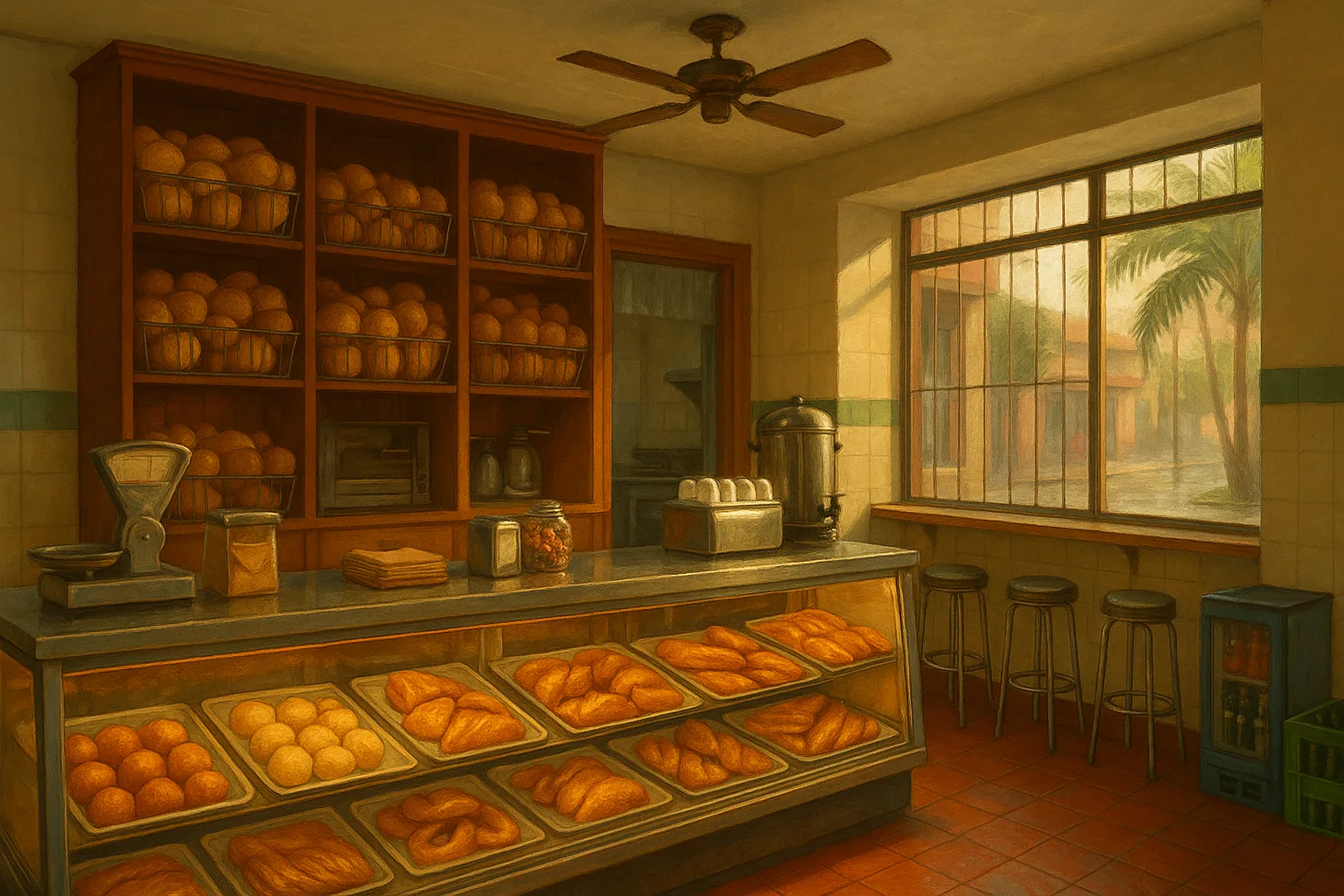
Paisa Spanish does something no textbook prepares you for: it often uses «usted» even with the people closest to you — friends, family, the dog. Not distance, just how affection sounds here. Wílmar opens Panadería La Aurora before six, greets you with «¿Qué más? ¿Cómo amaneció?», and will have poured you a tinto before you have decided anything. The politeness runs on «¿Me regala…?» and «con mucho gusto», and it is genuinely one of the easiest accents to follow.

¡Buenas! ¿Le provoca un tintico?
How Medellín actually talks
What you'll pick up
- The paisa «ustedeo» — usted even with the people closest to you — and why that reads as warmth rather than formality
- «¿Me regala un tinto?» — a common Colombian way to order, which is not asking for a gift
- Everyday paisa: parce, bacano, chévere, ¡hágale!, ¡qué pena!, and «con mucho gusto» as the answer to thank-you
Where you'll practise in Medellín
40 missions across 7 scenes. Each mission is a real errand with a goal, a person who talks back, and a debrief afterwards in your own language.
-
Droguería Santa Lucía droguería
Luz Dary, Regente de farmacia behind the counter of a neighbourhood droguería in El Poblado, Medellín · 5 missions · A1–B2
- Algo para el dolor A1 — In Colombia a pharmacy is a «droguería» and pills are sold loose. Ask Luz Dary for something for a headache, say how many, and pay.
- Los zancudos A2 — Already bitten, and off to hot country. Get a cream for the bites and a repellent for the trip — and hear why Medellín's sun calls for «bloqueador».
- Get to know Luz Dary B1 — No medicine today — just a chat. Night classes, the lady who comes in for her blood pressure every morning, and a dream that lives in a cold mountain town.
+ 2 more at this scene
Start speaking — free → -
Hotel Casa Guayacán hotel
Catalina, Receptionist at a small family hotel in Laureles, Medellín · 5 missions · A1–B2
- Check in A1 — Arrive at a small Medellín hotel: say you have a reservation, give your name and passport, get your key.
- The full check-in A2 — Nights, passport, balcony or quiet room, breakfast time, key and wifi — a whole paisa check-in.
- Get to know Catalina B1 — A quiet hour at the front desk. Find out where Catalina's from, how she got here, and what she dreams of.
+ 2 more at this scene
Start speaking — free → -
Estación Poblado estación del metro
Jhon Jairo, Ticket-booth and information attendant at Estación Poblado on the Metro de Medellín · 5 missions · A1–B2
- Un viaje A1 — Ask Jhon Jairo for a single metro trip at Estación Poblado, pay, and head for the turnstile. Your first ride in Medellín.
- Recargar la Cívica A2 — Top up Medellín's metro card at the taquilla — and learn the one rule every paisa knows: on the metro, nobody eats.
- El cable a Arví B1 — Metro north, a transfer to the cable, a second cable to the forest park — and a thunderstorm over the hills. Get the route, then make a call.
+ 2 more at this scene
Start speaking — free →
Explore all 7 scenes
-
Panadería La Aurora panadería de barrio
Wílmar, Counter man and part-owner of a corner panadería in the Laureles neighbourhood of Medellín · 7 missions · A1–C1
- Un tinto y un pandebono A1 — The four-minute Colombian breakfast: answer «¿qué más?», ask for a tinto, point at the thing you can't name yet, pay, go.
- El desayuno y el sencillo A2 — Ask what everything is, order for three, get the total — and then discover that at this hour «no hay sencillo» and your note is far too big.
- El encargo del jueves B1 — Breakfast for eight on Thursday. The oven runs at half past five and at half past ten, and pandebono is only pandebono for an hour — so plan around the clock, not the count.
+ 4 more at this scene
Start speaking — free → -
Fonda Doña Gilma restaurante
Fredy, Runs the floor at his family's lunch spot in Belén, Medellín · 5 missions · A1–B2
- Lunch and a juice A1 — Order one plate and a fresh juice — and answer the very Colombian question: «¿en agua o en leche?»
- Almuerzo del día A2 — Soup first, then the «seco» and a juice — order Medellín's everyday set lunch and ask for the bill like a local.
- Get to know Fredy B1 — After the lunch rush: the story of the fonda, his mother's kitchen, and the recipe book he's writing.
+ 2 more at this scene
Start speaking — free → -
Cancha de Tejo La Mecha cancha de tejo
Doña Doris, Owner of a neighbourhood tejo court in Manrique, Medellín, and the best thrower in the building · 6 missions · A1–C1
- Get on a lane A1 — The lane costs nothing, the beer is the rent, and the metal disc is borrowed — the four short sentences that get you playing tejo.
- How this works A2 — The ring, the gunpowder packet, the bang, and the score — get the rules of Colombia's national sport out of the woman who folds the mechas herself.
- Doña Doris B1 — A bricklayer from Boyacá who built four lanes behind the house in 1979, two hundred hand-folded gunpowder packets a week, and a lot she will not sell.
+ 3 more at this scene
Start speaking — free → -
Finca La Esperanza finca cafetera
Doña Amparo, Third-generation coffee grower who runs her family's finca cafetera on a hillside outside Salento, Quindío · 7 missions · A1–C1
- Llegar a la finca A1 — «¿Qué más?» is hello, not a question about the news. Your name, where you're from, how many of you — and yes to the tinto.
- Recoger cereza A2 — Into the rows with a basket on your belt. How long, how much, which ones are ripe — and «¿esta sí sirve?» for everything you're unsure about.
- De la cereza al pergamino B1 — Despulpar, fermentar, lavar, secar. Ask how and why, help get the patio covered before the rain lands, then say the whole process back in order.
+ 4 more at this scene
Start speaking — free →
Words that change in Medellín
Wílmar speaks the way Medellín does, not the way a textbook does. A few of the swaps you'll hear from the first minute — the full list lives in the app's «Talk like a paisa» guide:
| They say | It means | You'll hear |
|---|---|---|
| tinto | small black coffee elsewhere: café solo | ¿Me regala un tinto, por favor? The big false friend. In Colombia "un tinto" is a little cup of black coffee, drunk all day long; in Spain and most of Latin America "tinto" means RED WINE. Ask for a tinto in Madrid and you will be handed a glass of wine. |
| arepa | flat maize cake | Un tinto y una arepa con quesito. Eaten at any hour. The paisa version is thin, plain and white, split and buttered or topped with "quesito" — not the thick stuffed Venezuelan kind. |
| buseta | small city bus elsewhere: autobús | Coja la buseta en la esquina. The little privately run bus; a full-size one is a "bus" and Medellín's rail system is simply "el metro". |
| plata | money elsewhere: dinero | No cargo plata en efectivo. The everyday word for money across Colombia — literally "silver". "Dinero" sounds like a bank form. |
| camello | work / a job elsewhere: trabajo | Conseguí camello en el centro. A job, especially a hard-slogging one; the verb is "camellar". Literally "camel" — the animal that plods on and on. |
| guaro | anise liquor elsewhere: aguardiente | Nos tomamos unos guaros en la finca. Antioquia's own drink, sold as Aguardiente Antioqueño. "Guaro" is the affectionate short form most people actually use. |
| saco | sweater / jumper elsewhere: suéter | Lleve saco que en la finca hace frío. In Colombia a "saco" is a knitted sweater; elsewhere the same word can mean a suit jacket or a sack. |
| cuadra | city block elsewhere: manzana | La panadería queda a dos cuadras. Directions in Colombia are usually counted in "cuadras", not "manzanas". |
- parce — mate / dude Short for "parcero". The paisa word that went national — constant between friends and peers, but never with an elder, a customer, or someone serving you.
- bacano — great / cool Broad approval for a thing, a plan or a place. A person who is good company is "bacano" too.
- chévere — nice / cool Slightly gentler and more pan-Colombian than "bacano"; safe with anyone, any age.
- berraco — gutsy / formidable / brilliant Also spelled "verraco". High praise in Antioquia — tough, hard-working, admirable. "Una berraquera" is something amazing; "estar berraco" instead means to be furious, so let tone and context decide.
How Colombia says 27 everyday words — next to what seven other Spanish-speaking countries say for the same thing, with a cited source for every filled cell. Or see all the words, eight ways.
Questions people ask about Medellín
Which Spanish will I hear in Medellín?
Paisa (Colombian) Spanish. Wílmar and the other locals in the Medellín scenes speak the way people in Medellín actually speak — accent, pace, register and vocabulary. They'll say tinto for small black coffee, arepa for flat maize cake and buseta for small city bus, and the coach tells you when a word is local rather than universal. For the vocabulary side, see how Colombia says everyday words next to seven other countries at /spanish/colombia/.
Do I need to speak Spanish already?
No. Missions in Medellín run from A1 (first words: greet, order, ask for the bill) to C1 (argue a point, handle a complication, hold a real conversation). You pick a level, the scene meets you there, and the coach explains anything you missed in your own language.
What will I actually do in the Medellín scenes?
40 missions across 7 scenes — Droguería Santa Lucía, Hotel Casa Guayacán, Estación Poblado and Panadería La Aurora and more. Each mission is an errand with a goal: order, negotiate, describe a symptom, get directions, small-talk your way through a wait. The person you're talking to has their own agenda, so it never goes exactly to script.
Is it free?
You can start speaking without creating an account. A free account keeps your notebook and progress and comes with 10 minutes of live conversation a week, refilled every Monday; the app tells you where you stand.
How does the feedback work?
Wílmar answers in Spanish, and a separate coach watches the conversation and flags what to fix — grammar, a word choice that isn't Medellín's, pronunciation — in your language, without interrupting the scene. Words you didn't know go into your notebook with the Medellín pronunciation, and after each mission you get a debrief you can review.