🇦🇹 Vienna · German
Learn Austrian German in Vienna — Melange, Schmäh, and «es geht sich aus»
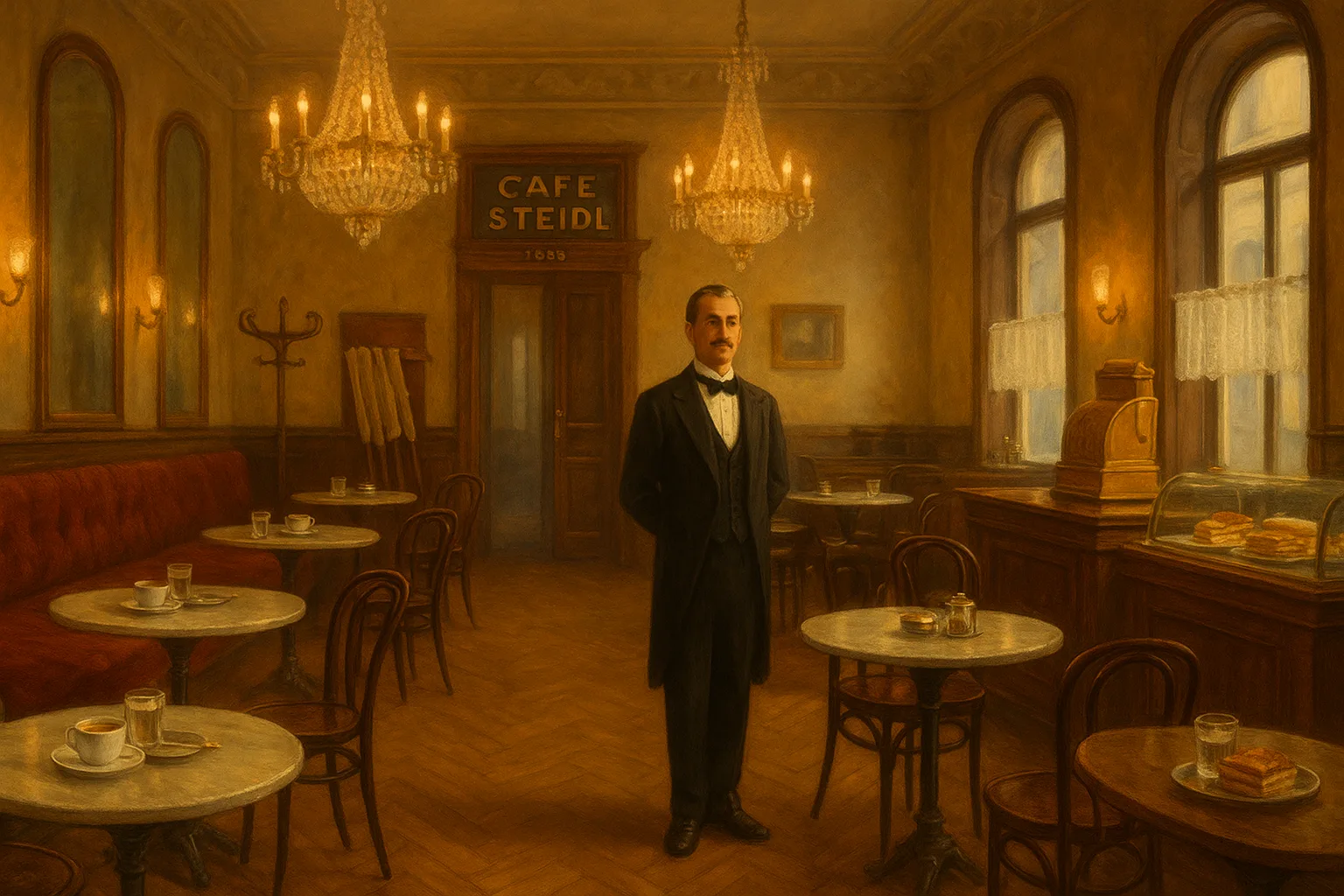
Austrian German greets with «Grüß Gott», bags come as Sackerl, and the untranslatable «es geht sich aus» runs daily life. Herr Leopold's Kaffeehaus teaches Viennese courtesy — the measured Sie, the coffee menu with eleven names, the dry Schmäh underneath it all.

Grüß Gott! Was darf es sein?
How Vienna actually talks
What you'll pick up
- Austrian vocabulary German courses skip: Sackerl, Semmel, Paradeiser, Marille, Melange
- The Kaffeehaus register — old-world Sie courtesy as living language, not costume
- «Es geht sich aus» and the Austrian art of things just barely working out
Words that change in Vienna
Herr Leopold speaks the way Vienna does, not the way a textbook does. A few of the swaps you'll hear from the first minute — the full list lives in the app's «Talk like a Wiener» guide:
| They say | It means | You'll hear |
|---|---|---|
| das Sackerl | bag elsewhere: die Tüte | Brauchst du ein Sackerl dazu? The -erl diminutive is everywhere in Austria. Ask for a "Tüte" and they'll know you learned your German up north. |
| die Semmel | bread roll elsewhere: das Brötchen | Zwei Semmeln, bitte. The Kaisersemmel with its star-shaped top is the classic Austrian roll; "Brötchen" sounds German-German. |
| der Paradeiser | tomato elsewhere: die Tomate | Ein Kilo Paradeiser, bitte. From "paradise apple". Market vendors say Paradeiser; "Tomate" is understood everywhere. |
| die Marille | apricot elsewhere: die Aprikose | Die Marillen aus der Wachau sind heuer besonders süß. Sacred word — Marillenknödel, Marillenmarmelade. Calling a Wachau Marille an "Aprikose" borders on an insult. |
| die Jause | snack, light meal elsewhere: der Snack / die Zwischenmahlzeit | Machen wir eine kleine Jause? The between-meals bite; a "Jausenstation" serves cold platters. The verb is "jausnen". |
| die Melange | the classic Viennese coffee elsewhere: der Milchkaffee | Eine Melange, bitte. Half coffee, half warm milk with foam — the default Kaffeehaus order. Never ask for a "Cappuccino" in a proper Kaffeehaus. |
| das Obers / Schlagobers | cream / whipped cream elsewhere: die Sahne / Schlagsahne | Den Einspänner mit viel Schlagobers, bitte. "Sahne" is the German-German word; in Vienna cream is Obers, whipped it becomes Schlagobers. |
| der Erdapfel | potato elsewhere: die Kartoffel | Ein Schnitzel mit Erdäpfelsalat, bitte. Literally "earth apple" (like French pomme de terre). Erdäpfelsalat is the canonical Schnitzel side. |
- leiwand — great / awesome The Viennese seal of approval — casual, warm, and only used in and around Vienna.
- ur- — very (intensifier) Glues onto almost anything — urgut, urnett, urteuer. Young, casual Viennese; don't use it with your Ober.
- der Schmäh — Viennese wit / charming banter Dry, ironic, delivered deadpan — half joke, half worldview. "Schmäh führen" is to banter; being on the receiving end is a compliment.
- das Beisl — simple neighbourhood tavern Vienna's bistro: plain wood, honest food, cheap wine. Likely from Yiddish "bajis" (little house).
Where you'll practise in Vienna
40 missions across 6 scenes and 1 guided tour. Each mission is a real errand with a goal, a person who talks back, and a debrief afterwards in your own language.
-
Das Beisl landmark
Herr Ferdl, Wirt of Beim Swoboda, a traditional Beisl in Vienna's 8th district · 3 missions · A1–C1
- Your Vienna day A1 — The lull after lunch: tell Herr Ferdl three small things you did in Vienna today, one sentence at a time.
- Book Sunday A2 — The Sunday Schweinsbraten: say you're coming, how many, twelve or one — and never after two.
- The birthday feast C1 — Twelve guests, a vegetarian, the sacred Stammtisch corner: negotiate the whole feast out of Herr Ferdl.
-
Funkstube Handyshop
Ines, Owner of a small independent mobile-phone shop in Vienna-Margareten · 6 missions · A1–C1
- A prepaid SIM A1 — Your first Austrian number. Ask for a Wertkarte, show your passport, pick an option, and pay.
- Prepaid or contract A2 — Compare the Wertkarte with a contract, find out what «Mindestvertragsdauer» means, and decide.
- Meet Ines B1 — Quiet morning in the shop. Ask Ines about the place, why she quit the chain store, and her favourite customer.
+ 3 more at this scene
-
Café Steidl Kaffeehaus
Herr Leopold, Ober (head waiter) of Café Steidl, a classic Wiener Kaffeehaus · 10 missions · A1–C1
- Order a Melange A1 — Order one Melange from Herr Leopold with a simple set phrase, and thank him.
- Meet the Ober A1 — The Melange is served — introduce yourself, ask the Ober his name, his forty years, and the age of the house.
- Coffee and torte A2 — Order coffee and a slice from the vitrine, learn the sit-down customs, and ask Herr Leopold for the bill.
+ 7 more at this scene
-
Naschmarkt — Stand Zsófia Markt
Zsófia, stallholder at the Naschmarkt, Vienna · 9 missions · A1–C1
- Buy some Marillen A1 — Buy one bag of apricots from Zsófia with a simple set phrase, and thank her.
- Taste, then buy A2 — Taste samples at the stall, order in Deka and quarter kilos, and pay Zsófia.
- Meet Zsófia A2 — Between tastings: the family from Sopron, twenty years at the stall, and why they're Marillen — never Aprikosen.
+ 6 more at this scene
-
Salon Michi Friseursalon
Michi, Hairdresser and owner of a small salon in Vienna's Neubau district · 6 missions · A1–B2
- Meet Michi A1 — Say your name, ask hers, and find out how long the little salon — «die Trafik» — has been hers.
- Chair talk A1 — The classic salon question: tell Michi three small things you did today, one sentence at a time.
- Just the tips A1 — Tell Michi what you want — tips only, two centimeters, shorter at the sides — and check the mirror.
+ 3 more at this scene
-
Beim Swoboda Beisl
Herr Ferdl, Wirt of Beim Swoboda, a traditional Beisl in Vienna's 8th district · 6 missions · A1–C1
- Sit down and order A1 — A dark old Viennese tavern, a checked tablecloth and a landlord with a cloth over his arm: say Grüß Gott, ask for a table, order one drink.
- Order lunch A2 — The dish of the day off the blackboard, dumplings or potato salad, a Gespritzter — and the bill brought to your table the Viennese way.
- Send it back B1 — Rice instead of potato salad, and a lukewarm Schnitzel. Say so politely, hold your ground through the grumbling, and get it fixed.
+ 3 more at this scene
Tours
- Wien schmeckt with Resi, Vienna food historian and food-tour guide — 5 stops: Der Naschmarkt, Der Würstelstand, Das Beisl, Die Sachertorte and Der Heuriger.
Questions people ask about Vienna
Which German will I hear in Vienna?
Austrian German. Herr Leopold and the other locals in the Vienna scenes speak the way people in Vienna actually speak — accent, pace, register and vocabulary. They'll say das Sackerl for bag, die Semmel for bread roll and der Paradeiser for tomato, and the coach tells you when a word is local rather than universal.
Do I need to speak German already?
No. Missions in Vienna run from A1 (first words: greet, order, ask for the bill) to C1 (argue a point, handle a complication, hold a real conversation). You pick a level, the scene meets you there, and the coach explains anything you missed in your own language.
What will I actually do in the Vienna scenes?
40 missions across 6 scenes — Das Beisl, Funkstube, Café Steidl and Naschmarkt — Stand Zsófia and more. Each mission is an errand with a goal: order, negotiate, describe a symptom, get directions, small-talk your way through a wait. The person you're talking to has their own agenda, so it never goes exactly to script. There is also a guided tour — Wien schmeckt — where the guide talks and you ask.
Is it free?
You can start speaking without creating an account. A free account keeps your notebook and progress and comes with a monthly allowance of speaking minutes; the app tells you where you stand.
How does the feedback work?
Herr Leopold answers in German, and a separate coach watches the conversation and flags what to fix — grammar, a word choice that isn't Vienna's, pronunciation — in your language, without interrupting the scene. Words you didn't know go into your notebook with the Vienna pronunciation, and after each mission you get a debrief you can review.